The Status Page Aggregator That Warns You Before Vendors Do
Aggregate thousands of vendor status pages into one dashboard. Get outage alerts when your cloud dependency breaks, before the official status page even updates.
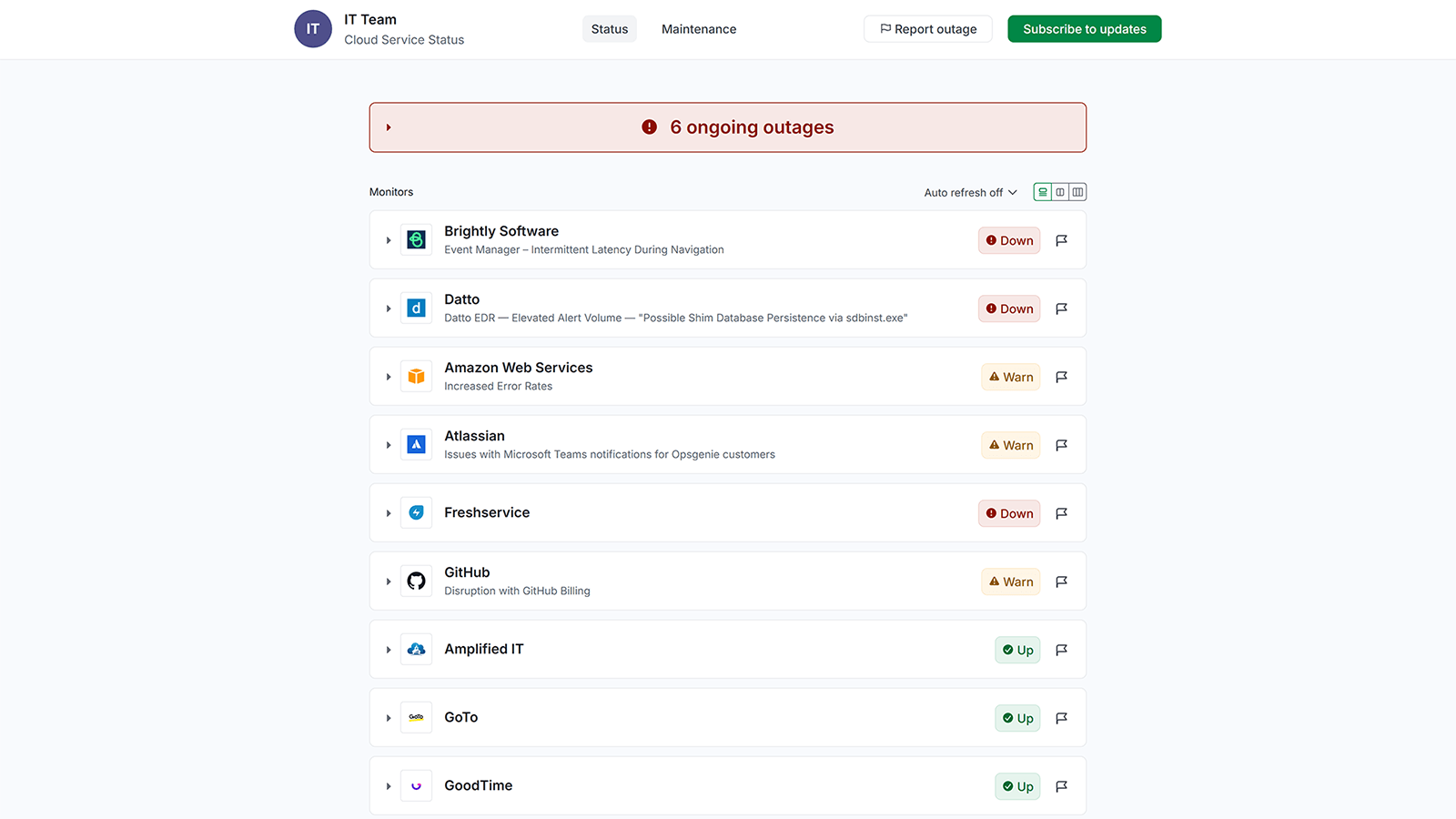
Aggregate thousands of vendor status pages into one dashboard. Get outage alerts when your cloud dependency breaks, before the official status page even updates.
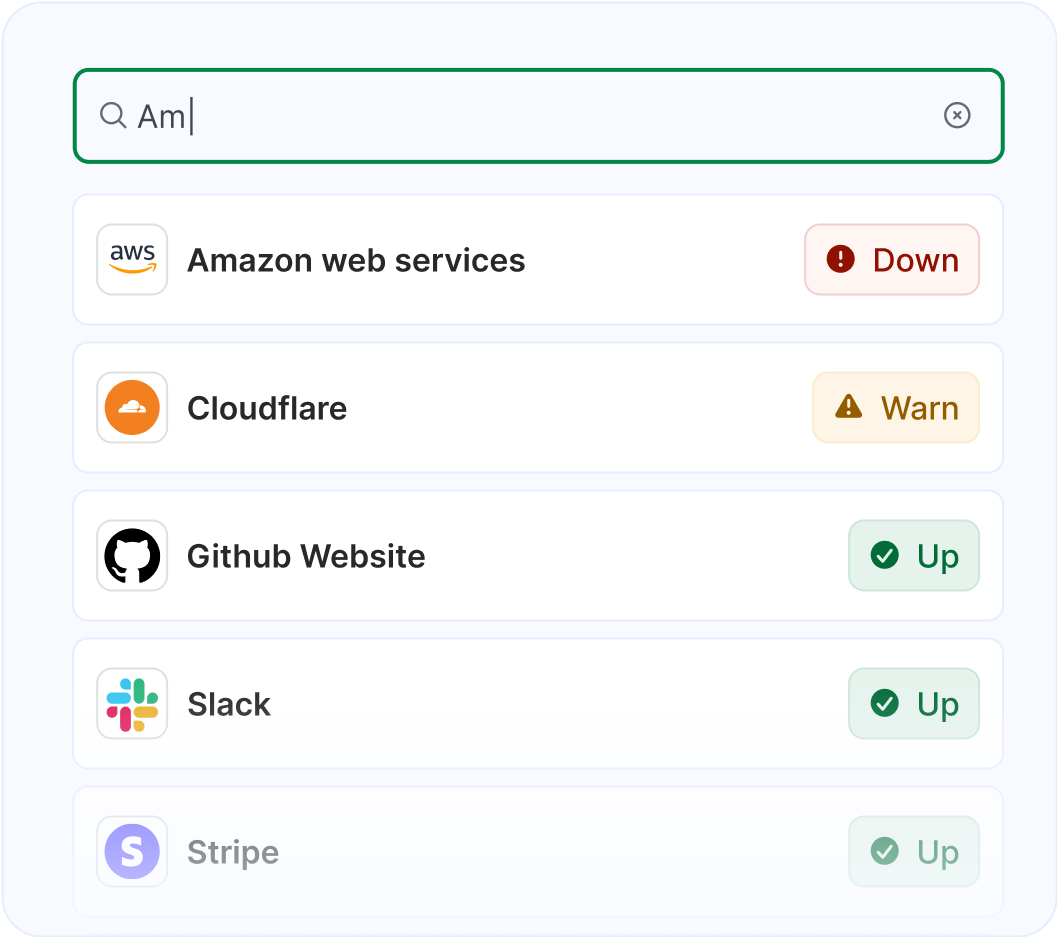
A status page aggregator pulls in the public and private status pages of every vendor you depend on — cloud infrastructure, SaaS tools, APIs — and monitors them from one place. Instead of bookmarking two dozen status pages and checking each one by hand, you get a single dashboard, unified alerts, and one early-warning system across your entire vendor stack.
It's built for IT teams, DevOps, MSPs monitoring on behalf of clients, and any team that can't afford to be the last to know when a vendor goes down.
Stop checking status pages by hand. No more tab-hopping across dozens of vendor sites during an incident.
Catch third-party outages early — often before the vendor's own status page confirms it.
Cut support tickets by telling your team (and customers) what's happening before they ask.
Respond faster. Centralized alerts mean less time diagnosing "is it us or them."
IT teams monitoring the SaaS vendors the business depends on
DevOps teams tracking cloud infrastructure and service dependencies
MSPs monitoring vendor health on behalf of clients
Enterprises that need centralized visibility across a large, unmanaged vendor footprint
Vendor risk & competitive intelligence teams tracking reliability over time
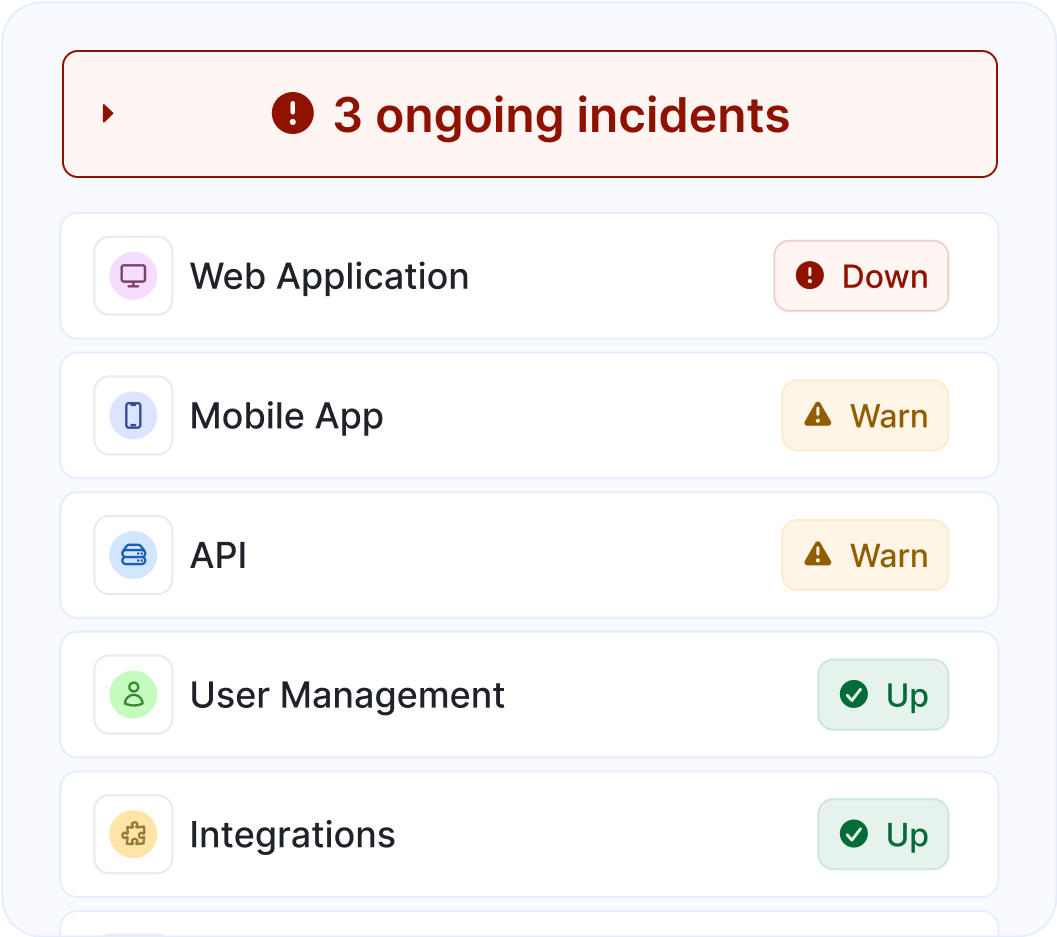
StatusGator pulls status data from public status pages via RSS, API, and HTML parsing — and from private status pages (Microsoft 365, Cisco Meraki, Zendesk, and others) on Enterprise plans.
Every format gets normalized into one consistent status model.
You see it all on a single dashboard.
When something breaks, you're alerted via Slack, Teams, email, or webhook — before you'd have found out on your own.
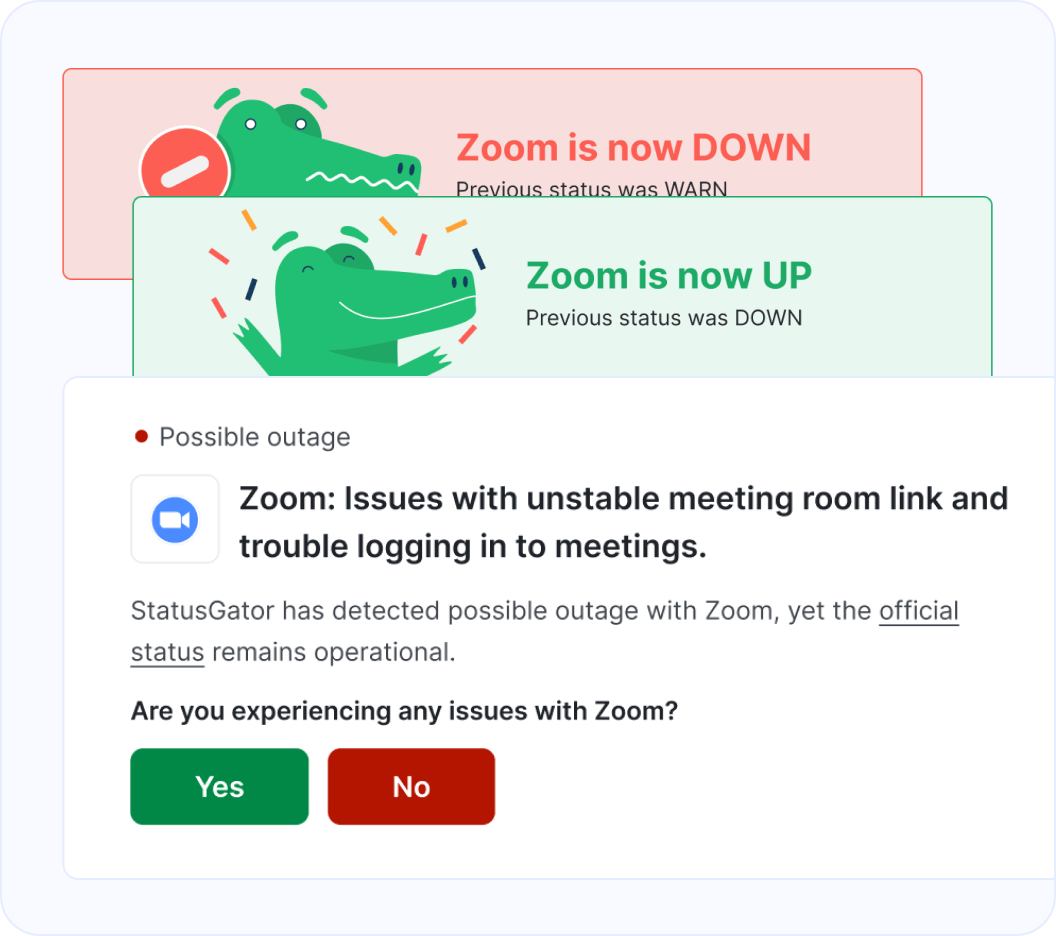
Behind every vendor you track, StatusGator is pulling in thousands of data points per minute and running them through proprietary detection algorithms every 60 seconds. This constant scanning means StatusGator often flags degradation or outage before the vendor's own status page reflects it. So your team gets real lead time to investigate, notify stakeholders, or fail over, not just a faster confirmation of what you already knew.
Try for Free| Features | StatusGator | Open-Source Status Page Aggregator |
|---|---|---|
| Number of vendors monitored | ★★★★★ | ★★☆☆☆ |
| Custom alerts | ★★★★★ | ★★★☆☆ |
| API | ★★★★★ | ★★★☆☆ |
| Early outage alerts | ★★★★★ | |
| Private status ingestion | ★★★★★ | ★★☆☆☆ |
| MCP | ★★★★★ | ★☆☆☆☆ |
| Request a demo | See on GitHub |
Trying Early Warning Signals on your critical vendors — no credit card, no catch.
Small teams that need private status pages and custom domains.
Growing teams that need monitoring and third-party status page integrations.
Larger teams that need incident management integrations (PagerDuty, Opsgenie).
Private status ingestion (AWS, Azure, GCP, Microsoft 365), authenticated status pages, dedicated support.
14-day free trial on every paid plan. No credit card required. Cancel anytime.
5.0 ★★★★★ — Rated on Capterra, GetApp, and Software Advice. 1,000+ companies rely on StatusGator to monitor their vendor stack.
A status page aggregator collects and centralizes status information from multiple vendors into a single, unified view. StatusGator monitors 10,000+ official status pages, giving IT teams and businesses consolidated, real-time updates plus historical data to track operational impact.
Yes. StatusGator lets you monitor hundreds or thousands of vendor status pages simultaneously from one customizable dashboard, covering status, incidents, outages, and scheduled maintenance.
UptimeRobot acquired IsDown and is launching its dependency-monitoring engine as a bundled add-on inside its uptime tool, with hard monitor caps by plan (as low as 1–5 dependency monitors on the entry tier) and nothing at all on the free plan. StatusGator is a dedicated aggregation product: Early Warning Signals is included on every plan, including Free, and vendor allowances are more generous at every comparable tier (up to 150 on Corporate, uncapped on Enterprise). StatusGator also has a longer track record, detecting outages before official announcements, including publicly documented cases like catching a SentinelOne outage nearly an hour early, plus a free open-source aggregator on GitHub and up to 24 months of historical uptime data on Enterprise.
Yes. StatusGator's free plan monitors up to 3 vendors with a dashboard view, basic notifications, and Early Warning Signals included — Early Warning Signals isn't gated to paid plans. Higher vendor limits, SMS alerts, help desk integrations, and deeper monitoring integrations open up starting at $72/month.
A status page is published by a single vendor to communicate its own service health. A status page aggregator pulls information from many of those pages into one view, so you're not visiting dozens of sites individually.
Yes, on the Enterprise plan. StatusGator supports Private Status Ingestion for systems with private APIs or authentication requirements, including Microsoft 365, Cisco Meraki, and Zendesk.
Up to 24 months on the Enterprise plan, scaling down by tier (1 month on Free, up to 12 months on Corporate). It’s useful for spotting patterns in a vendor's reliability over time, not just reacting to the latest incident.
Yes. StatusGator sends alerts via Slack, Microsoft Teams, Discord, email, and webhooks, so incidents reach the tools your team already works in.
StatusGator offers a free, open-source status page aggregator on GitHub for teams that want to self-host. The hosted product adds Early Warning Signals, private status ingestion, and managed infrastructure on top of that foundation.
StatusGator has a free plan for monitoring 3 vendors, with paid plans from $72/month (Starter) up to $274/month (Corporate), and custom Enterprise pricing with uncapped monitors, private status ingestion, and extended historical data. Every paid plan includes a 14-day free trial with no credit card required. Full pricing is available on the pricing page.
Don’t wait for the next outage. Be the first to know when your services go down.